
The “Tenure Gap”: Solving the Tenant Farmer’s Dilemma
By Shawn Gagné, Chief Carbon Commercial Officer
The Structural Barrier to 2030 Climate Goals
Around 54% of U.S. cropland is leased, often on year-to-year or short-term contracts. That means that over half of US farmers are tenant farmers, operating on land they do not own and investing in soil improvements whose long-term financial benefits they may never personally realize.
This incentive structure naturally favors short-term returns over long-term soil investments. When lease renewal is uncertain, yield stability today takes precedence over stewardship benefits that may materialize years later.
This reality creates a dilemma for soil carbon dioxide removal (CDR) projects. Most high-quality CDR projects require investment horizons of 10 years or more. Yet a typical tenant farmer cannot economically justify even a five-year soil health investment when their lease may end in 12 months.
This mismatch generates an “Investment Cliff” – a structural barrier that keeps a significant share of the U.S. breadbasket out of the carbon market. Farmers are the essential actors in this system. But when their role is structurally aligned with short-term risk management rather than long-term stewardship, scalable soil CDR becomes difficult to achieve.
Standard Soil Projects and the Tenure Test: Where Friction Emerges
The Lag Time Problem
Traditional regenerative transitions often require substantial changes to land management practices, such as reduced tillage or complex cover cropping systems. These transitions can temporarily disrupt established production systems, and in many cases, farmers can experience a yield dip in years 1–3 as soil biology gradually rebuilds. Financial returns may not stabilize until year 5 or later.
For growers already facing tight margins, weather volatility, and global price fluctuations, this delayed payoff creates a significant barrier to adoption. Risk tolerance is limited when the estimated time-to-payoff extends beyond the certainty of the lease.
The Operator Adoption Barrier
Corporate buyers are rightly focused on scalability and true additionality.
If a program is structured so that only landowners can participate, it leaves more than half of US cropland on the sidelines and forecloses participation for the majority of the operational market.
This creates another structural obstacle: the primary actors required to deliver scalable carbon removal – the growers – are often the least able to assume long-term financial risk, regardless of the soundness of the soil projects themselves.
The result is a persistent tenure gap, where the farmers most in need of liquidity are the ones least able to access carbon finance.
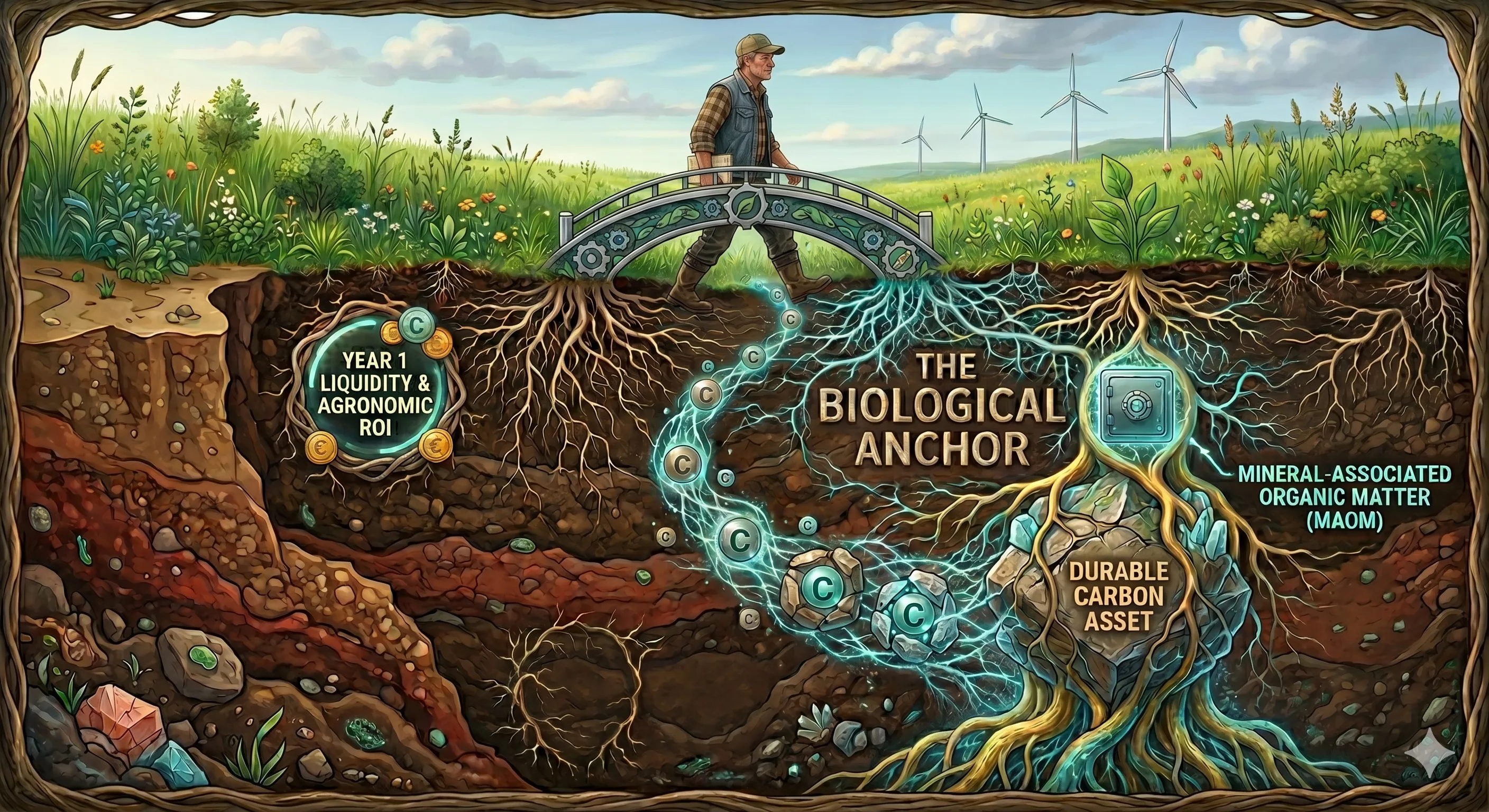
Rootella Carbon Bridges the “Investment Cliff” by Design
Immediate Liquidity
Unlike traditional practice changes that require years to generate returns, Rootella Carbon delivers both agronomic benefits and carbon payments beginning in Year 1.
The immediate liquidity option offers a game-changing incentive to tenant farmers, upending the incentive structure. Instead of waiting years for returns that may never materialize, growers receive measurable value within the same contract cycle.
Decoupling Time from ROI
Mycorrhizal inoculants offer more than another input single practice change. They accelerate regeneration by restoring the soil’s original biological infrastructure – the natural network that has supported plant productivity for millennia.
As the foundation of the rhizosphere, mycorrhizal fungi act as a microbial “multiplier”, improving nutrient use efficiency and soil recovery. When mycorrhizal networks are rehabilitated, farmers can see measurable agronomic ROI within the same growing season, even without long-term land ownership.
This ability to earn compensation in the short term for investment in a long-term set of benefits helps align soil stewardship with the economic realities of tenant farming.
Carbon Payments as Risk Insurance
Carbon revenue is often described as a “second harvest” or an optional bonus. In reality, the additional carbon income stream functions as essential risk insurance. The payments help offset the cost of the inoculant itself and protect the farmer’s margin against the uncertainty of lease non-renewal. They also compensate growers for improvements happening below ground that may take time to become visible in above-ground yields. Rootella Carbon allows farmers to measure and monetize those invisible improvements immediately.
The “Biological Anchor”: Rooting Climate Physics in Carbon Contracts
From a buyer’s perspective, the value of a carbon asset is tied to the durability of the carbon stored in the land, regardless of the duration of the farmer’s lease.
Rootella Carbon addresses this gap in incentives through the biological infrastructure of mycorrhizal carbon itself. Even if a tenant leaves, the carbon sequestered within Mineral-Associated Organic Matter (MAOM) becomes physically and chemically protected in the soil’s deep layers.
Durability of the carbon asset rests on a layered foundation. The contractual structure follows VM0042’s pathway to a 100-year monitoring horizon, beginning with a 20-year initial term, and extending through up to four possible renewals. Program-level mechanisms, including the AFOLU buffer pool, address unintentional reversals. Biological reinforcement through Mineral-Associated Organic Matter (MAOM) physically and chemically protects the stored carbon within the soil’s deep layers. The biology does not replace the contract; it strengthens what the contract already covers.
Moving the Market from “Trials” to “Tenure”
For CDR to scale into a “gigacorn” industry, it must solve the tenant farmer challenge. Waiting for longer land leases to emerge is not a viable strategy. Instead, the evolving industry must adopt new solutions – such as shorter ROI cycles – that acknowledge the realities of the modern farmer. By solving the Tenure Gap challenge, Rootella Carbon taps the hidden potential of leased cropland, allowing it to participate fully in the CDR market and to return to its role as a high-integrity carbon sink.
To learn more about how Rootella Carbon aligns farmer incentives with buyer requirements, contact Shawn Gagné at [shawn@groundworkbioag.com] and the Rootella Carbon team.
Let Your Ground Work


