
The “Missing Middle”: Why Your 2030 Portfolio is Currently Uninsurable
By Shawn Gagné, Chief Carbon Commercial Officer
Welcome to our Biological Infrastructure thought leadership series, led by our Chief Carbon Commercial Officer and unofficial company philosopher, Shawn Gagné. This first entry analyzes the strategic portfolio gap that mycorrhizal infrastructure is uniquely positioned to fill.
The Modeler’s Reality Check
Years of climate risk modeling sharpen a reality-hardened perspective. In the world of carbon finance, risk modelers are privy to the high failure rates of low-cost programs and the fragility underlying the price-to-quality disconnect in secondary market markups. A chain of price markups often serves to “mask” underlying project risks; for inexperienced buyers, a higher price tag can create a false sense of security, equating cost with quality while the fundamental climate risk remains unmitigated.
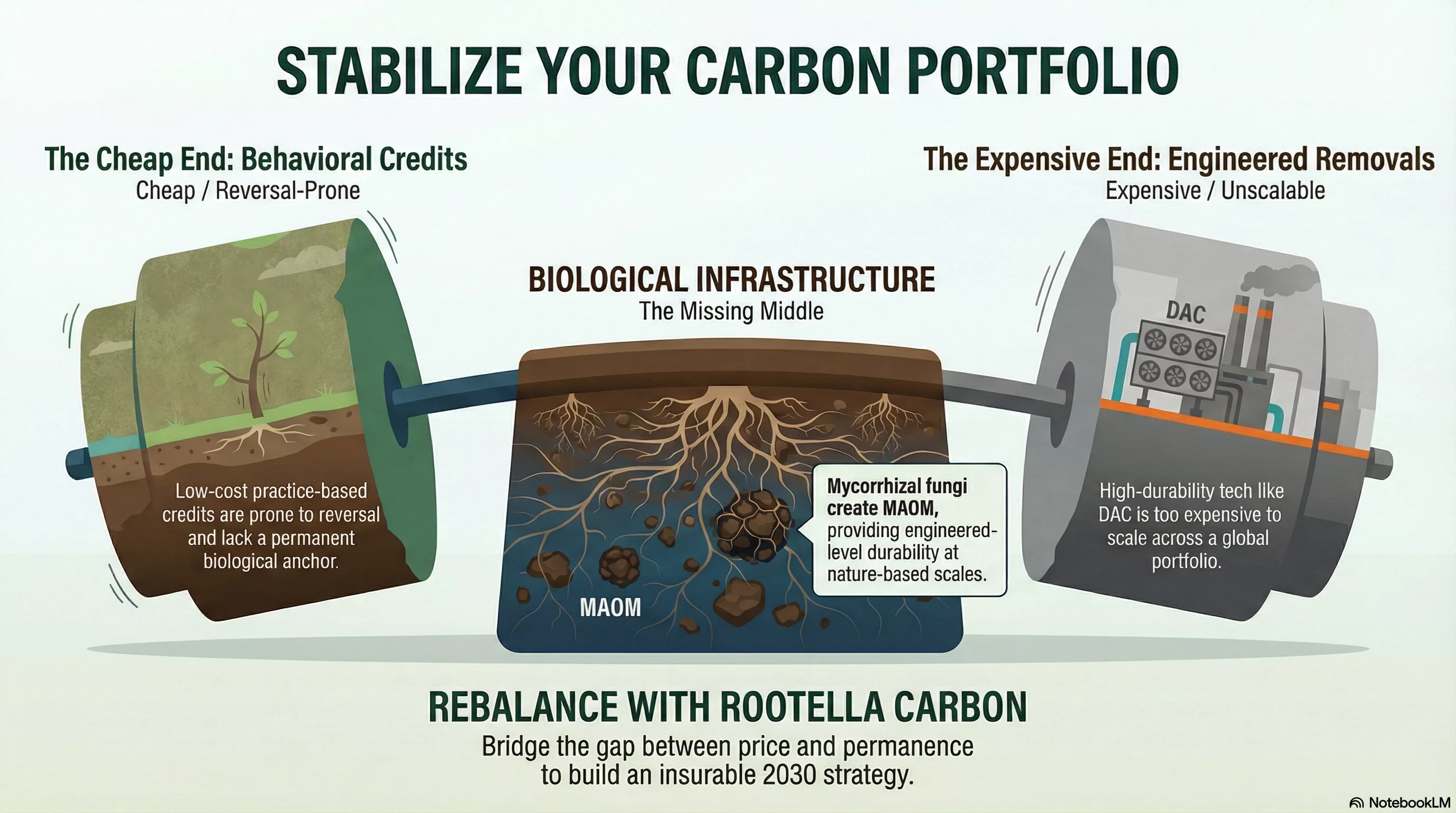
Today, the demand for robust, sustainable carbon portfolios is high. Yet the “mental models” currently used by many corporate sustainability departments fail to account for true project failure rates. The cause lies in the dangerous barbell shape of most corporate portfolios: heavy on cheap, reversal-prone “behavioral” credits and expensive, unscalable engineered removals.
The Portfolio Problem: The Unstable Barbell
All investment portfolios – whether for retirement or carbon – require diversity to mitigate risk and integrate longevity. However, current corporate carbon strategies are dangerously thin in the center.
The “Cheap” End: Behavioral Credits
Inexpensive behavioral credits rely on practice-based credits, such as standard no-till. However, grower behavior is context dependent. Practice changes can reverse with a single season of bad weather, a change in land ownership, or financial pressures during a tough year. From a modeler’s view, these credits are statistically likely to fail over the long term because they lack a biological anchor; the carbon remains near the surface, exposed and at risk of reversal.
The “Expensive” End: Engineered Removals
On the other side of the curve, investments in high durability projects like Direct Air Capture (DAC) offer stability but fail the scalability test. At a price point of $600 to $1,000 per ton, they make it financially impossible to fill a corporate portfolio sustainably.
The result is a structurally fragile, “barbell” shape: heavy on the ends, lacking a solid, scalable center and exposing companies to reputational and climate risk.
Introducing “The Missing Middle”
The market is missing a “Goldilocks” asset class: carbon removal that is scalable, durable, and cost-effective.
Forestry was historically the primary candidate for this middle ground. However, 2024 saw a market shift with the realization that REDD+ programs were held to an unsustainable standard of quality. While high-integrity agroforestry programs (such as those supported by Plan Vivo) offered quality options, they lack scale and often reach full capacity before credits are issued. Ultimately, the forestry sector – of which REDD+ represents over 60% of issuances since 2010 – remains hampered by land-use conflicts and permanence questions. Buyers are now actively searching for a solution that is neither “too cheap to be true” nor “too expensive to scale.”
Biological Infrastructure: The Master Asset Class
Biological infrastructure is the only technology currently capable of operating at scale with an accessible price point and high durability.
What is Biological Infrastructure?
Biological infrastructure refers to the mycelial pathways in soil, formed by mycorrhizal fungi. When restored, these fungi establish microbial superhighways that secure the soil’s carbon ‘vault.’
However, this infrastructure is more than just a biological benefit; it is a chemical engine. These specialized fungi drive the biogeochemical transformation of labile soil carbon into Mineral-Associated Organic Matter (MAOM). By chemically binding organic carbon to soil minerals like clay and silt, this biological infrastructure physically protects the carbon from microbial decay. The result is measurable, century-scale carbon durability akin to engineered removals, delivered at the scale of global agriculture. This establishes a new biological asset class that finally solves the ‘Missing Middle’ of the carbon market.
Rootella Carbon: The “Goldilocks” Breakthrough
Groundwork BioAg is the first to operationalize this biological infrastructure at a global scale. Our Rootella Carbon program delivers the “just right” balance of price, scalability and durability.
- Scalability and Price: Our proprietary production process makes high-concentration inoculants affordable for broad-acre farmers for the first time.
- Durability: The MAOM science provides “engineered” levels of carbon permanence at “nature-based” prices.
Rootella Carbon adds more than another credit to your portfolio; it anchors it in a core asset that investors need to build a resilient carbon credit strategy.
The Journey Ahead
Over the next year, we will take you through this space in depth. We’ll go on technical deep dives, zoom into field results, and track market shifts – arming you with the data and insights needed to build a successful portfolio.
The portfolio of the future is a balanced ecosystem resting on the fulcrum of biological infrastructure.
Join us on the journey. Reach out to Shawn Gagné to discuss rebalancing your carbon portfolio.
Rootella: Let Your Ground Work


