
The End of the Carbon Lease: Shifting from Farming Practices to Biological Hardware
By Shawn Gagné, Chief Carbon Commercial Officer
Welcome to our Biological Infrastructure thought leadership series, led by our Chief Carbon Commercial Officer and unofficial company philosopher, Shawn Gagné. This second entry reframes the regenerative agriculture narrative by distinguishing between grower behavior and soil biology.
The Reversal Risk Built into Regenerative Agriculture
Carbon Dioxide Removal (CDR) is in high demand, but the market is still struggling to supply the quality required by elite buyers. We are currently seeing a dialectical tension between nature-based quality and tech-based durability.
Premium corporate buyers know they need the scale of nature-based solutions, but they are hesitant to accept the permanence risks that typically come with them. Standard regenerative agriculture has become the industry’s default compromise: it’s a system where buyers are essentially renting short-term carbon storage instead of purchasing durable infrastructure.
Therein lies the conflict between carbon portfolio idealism and reality. Most agricultural offsets today pay for regenerative behavior – grower transitions to methods such as no-till and cover cropping. These are admirable practices that align with our shared aim of microbial soil regeneration, but behavior is reversible. If a farmer changes their mind, faces a challenging season, or a land lease ends, the carbon “lease” expires.
To achieve durable sequestration over the long term, we must decouple grower behavior from investment. At Groundwork BioAg, we see that the carbon offset industry is mature enough to stop subsidizing management habits and start investing in biological infrastructure.
Software vs. Hardware: A New Perspective on Soil Capital
The “Software” (The Practice)
Think of soil management as an operating system. Practices like cover crops and reduced tillage are software applications. They improve the system temporarily, but without the right underlying architecture to lock in those gains, their impact remains volatile and surface-level.
The “Hardware” (The Inoculant)
Software requires hardware to permanently store data, but decades of intensive farming have stripped the soil of its original hardware. We have to reinstall it. By reintroducing mycorrhizal fungi, we restore the soil’s physical architecture to capture and retain carbon even as surface conditions shift. Rather than depending on human habits, this biological technology integrates carbon storage directly into the soil’s chemistry as Mineral-Associated Organic Matter (MAOM).
Installing the Mycorrhizal Network
Physical Expansion
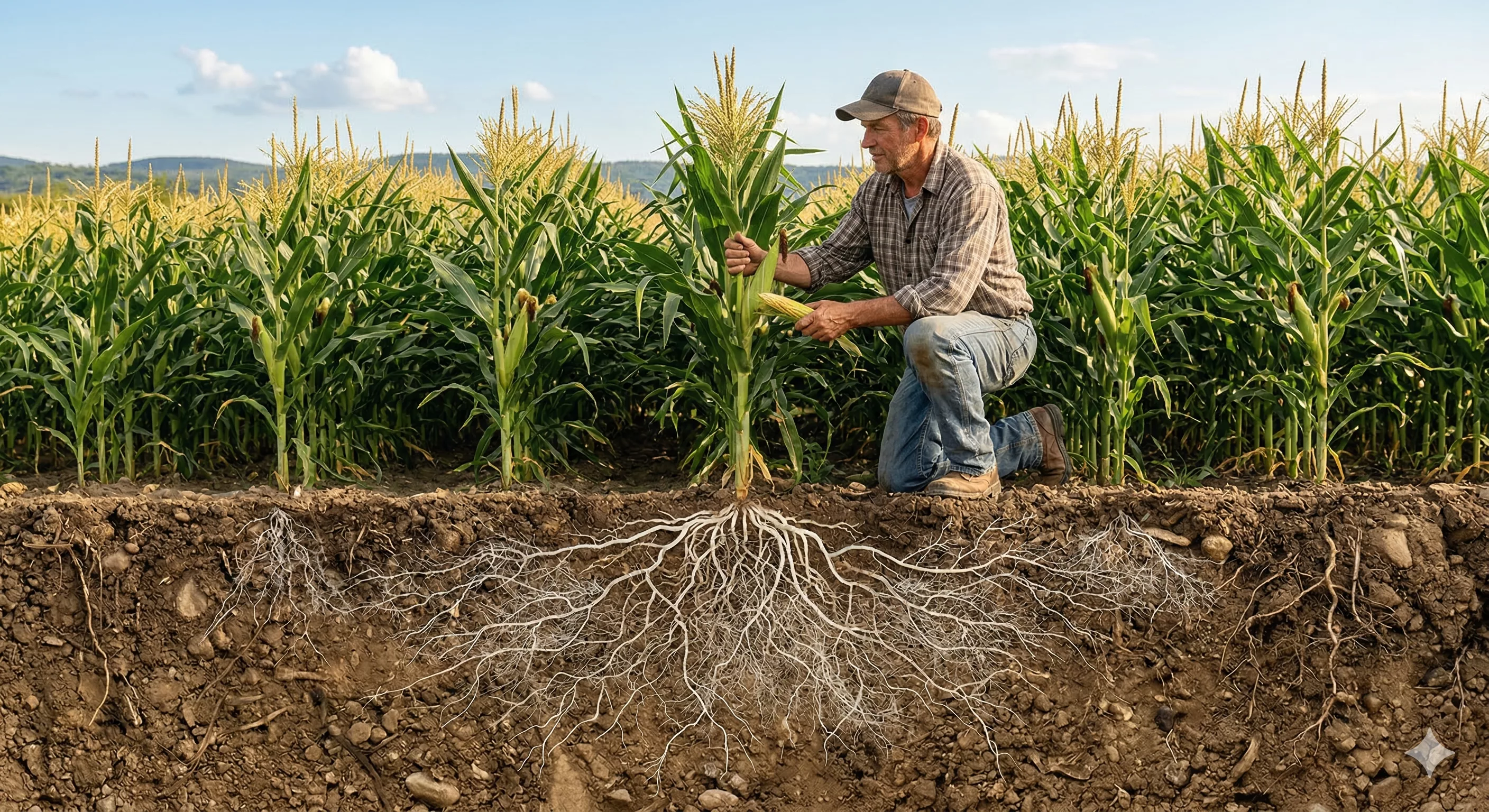
Rootella Mycorrhizal Inoculants begin the restoration of soil hardware by physically expanding the reach of the rhizosphere. By effectively extending root systems by up to 100x, this mycorrhizal network creates a vast, durable “filtration and storage” system. It enables access to vital nutrients and moisture far beyond the reach of roots alone, creating a symbiotic nutrient and carbon superhighway that remains active regardless of weather cycles or fertilization levels.
Chemical Stability
Mycorrhizae are also carbon’s main pathway into the deeper layers of soil. There, they embed deeply the carbon within the soil’s geology in durable compounds that remain stable for millennia. When the photosynthesized carbon binds to clay minerals, it generates Mineral-Associated Organic Matter (MAOM). This is the “hard drive” of the earth – a stable carbon vault where carbon is stored more securely and for longer durations than surface-level biomass.
The Myco-Multiplier Factor
Like adding a dedicated GPU to a computer, this hardware makes every other “program” (fertilizer, water, genetics) run more efficiently. As nature’s original Biological Infrastructure,it serves as the resilient foundation that ensures other inputs pay off by completing the nutrient delivery system. Mycorrhizae chemically and biologically synergize with bacteria, biostimulants and other microbials, amplifying the ROI and agronomic efficiency of the entire input portfolio.
From “Nature-Based” to “Biological Technology”
Nature-based solutions have often been pigeonholed as “low-tech/low-durability,” leaving Mycorrhizal Carbon without a category. We solve this classification conundrum by redefining mycorrhizal inoculants as Natural Bio-Tech that rebuilds foundational biological infrastructure within the soil.
- The Reliability Factor: The Reliability Factor: Biological hardware provides a measurable, repeatable mechanism for sequestration that isn’t dependent on the whims of weather, land ownership or commodity prices. Our Rootella Carbon program relies on a rigorous MRV approach utilizing a yearly ‘measure and remeasure’ method, with sampler boots on the ground, to meet Verra standards and guarantee durability.
- The ROI of Durability: High-integrity credits derived from “soil hardware” are the most secure way for top-tier buyers to meet 2030/2050 goals without the risk of future reversals. A reversal happens when surface-level carbon—often stored as fragile Particulate Organic Matter (POM)—is re-exposed to the atmosphere through tilling or weather events. Mycorrhizal fungi fundamentally alter this equation. This biological technology embeds carbon deep into the rhizosphere as Mineral-Associated Organic Matter (MAOM), locking it into the soil’s chemical architecture where it remains stable for centuries, independent of surface-level disruptions.
The Infrastructure of the Next Agricultural Revolution
Agriculture is a platform that leverages food security for the world’s most advanced, original carbon-capture hardware. This next wave of the agricultural revolution goes beyond changing how we grow crops to evolving how we cultivate soil.
We invite you to take a closer look at your 2026 portfolio. Are you investing with the mindset of a renter? Are you intrigued by the idea of committing to the re-installation of genuine biological infrastructure?
Join us on the journey. Connect with Shawn Gagné to discuss how to make biological hardware the stable foundation of your carbon portfolio.
Rootella: Let Your Ground Work


