
Financial Durability: How Agronomic Value Answers Both Additionality and Reversal Risks
By Shawn Gagné, Chief Carbon Commercial Officer
The Buyers’ Dilemma and Post-Contract Jitters
You’ve completed the due diligence. The sequestration is verified. The contract is signed. But two questions still keep your team up at night: Would this practice have happened without our carbon finance, and what stops it from unwinding when the contract ends?
Both questions point to the same underlying issue, and they have the same answer.
In a maturing carbon market, contractual safeguards and legal buffers do important work. They are necessary. But they are also reactive by design, activating after a problem occurs. They can penalize noncompliance, but they cannot create the conditions for ongoing success on their own.
What buyers actually need is a proactive safeguard: one that makes the practice a rational business choice, not just a legal obligation.
The “Paper Tiger” Problem: Why Legal Buffers Fall Short on Their Own
Farmers are, first and foremost, business owners. Their decisions are driven by margins, risk, and operational stability.
If a carbon-sequestering practice becomes a net cost to the farm, the grower will likely discontinue it once the contract expires. For a practice to stick, it must be financially viable for the farmers to maintain on its own merits.
This is the “stickiness” challenge facing many nascent carbon projects. Programs that depend on grower participation but rely solely on carbon payments for their economics to work have zero structural permanence. Without inherent agronomic value, a contract becomes a “paper tiger” that can enforce behavior for the duration of the agreement but cannot create the motivation to continue efforts afterward.
True Financial Durability is Anchored by Agronomics
True permanence in agriculture isn’t anchored by a contract; it is anchored by grower retention. A practice becomes durable when it consistently improves the farm’s bottom line.
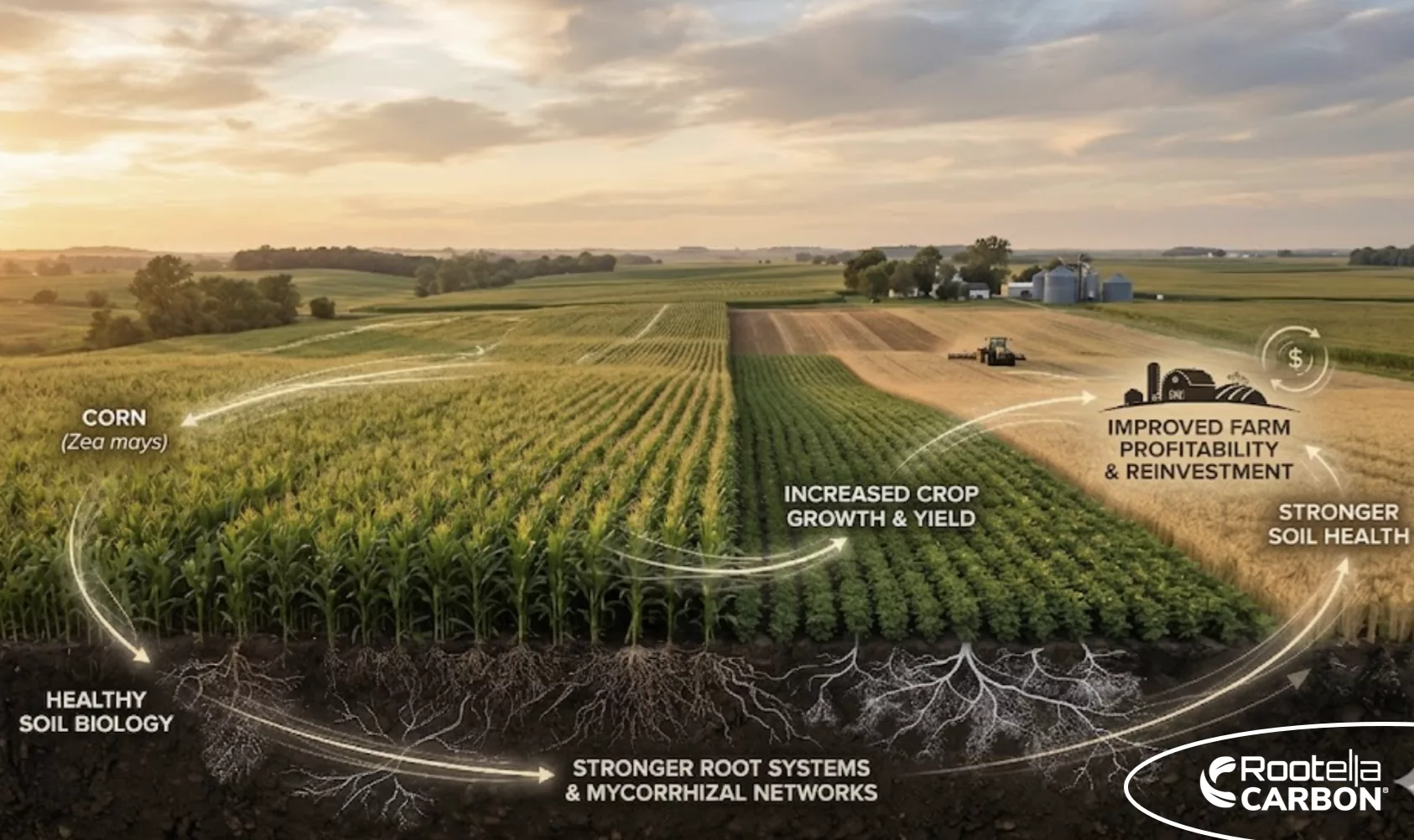
From the farmer’s perspective, the calculation is simple: If a biological input like Rootella mycorrhizal inoculants increases yield, reduces input costs, and builds soil resilience independent of the carbon credit, the farmer keeps using it. Carbon sequestration shifts from a temporary compliance activity into a byproduct of a profitable farming system.
This is “Financial Durability”: the condition where farmers maintain carbon-sequestering practices because they are profitable, not because they are required.
The Virtuous Cycle
Once Financial Durability is established, the cycle feeds itself. Adoption of mycorrhizal inoculation generates carbon revenue. That revenue is reinvested into the soil, expanding mycorrhizal colonization and lifting yields. Stronger biology reinforces the sequestration. Stronger sequestration generates more carbon revenue. Each season builds on the last.
In this framing, Mycorrhizal Carbon is a value driver rather than a cost line. It transforms what would otherwise be a climate liability into a soil productivity asset, with farmer economics and atmospheric outcomes reinforcing each other season after season.
The Additionality Answer
Here is where Financial Durability speaks directly to the additionality question CDR.fyi buyers raise in their DD processes.
The counterfactual test is straightforward: would this practice scale without carbon finance?
Biologicals work. The agronomic case for mycorrhizal inoculation is well established, and the growers who adopt it see strong returns on their own farms. Even so, North American adoption rates for biologicals remain low. The barrier is not the math; it is market inertia, first-mover risk, and the operational change of integrating a biological input into an established system.
Carbon finance is the catalyst that breaks through that inertia. It offsets the first-mover risk, accelerates adoption past the early-adopter curve, and moves the market from linear to exponential growth. Without it, biologicals continue to gain ground slowly, on a timeline that cannot meet the scale CDR markets require. With it, adoption reaches the pace and footprint that produce meaningful, verifiable sequestration.
That is the additionality story in one line: carbon finance does not create the value, it unlocks the scale.
What makes the program defensible against additionality scrutiny is that we can show the gap clearly. The agronomic case is documented: across 30 corn field trials from 2023 to 2025, Rootella produced an 86% win rate and an average yield advantage of +7.87 bu/ac, translating to a net per-acre ROI of +$28.55 at the six-year average corn price. Yet the broader market has not converted documented value into scaled adoption. Industry awareness of biologicals sits at 87% among US row-crop farmers, but 54% of non-adopters report they would only consider biologicals if recommended by a trusted peer or advisor. The barrier is not the math; it is social proof and first-mover risk. Carbon finance closes that gap by offsetting the risk of being first, converting proven agronomic value into the scale and pace of adoption that produces meaningful, verifiable sequestration.
The Reversal Answer
The same mechanism that solves additionality also solves reversal.
Once the biological infrastructure is in place and the agronomic benefits are proven on-farm, the grower’s incentive to continue is no longer dependent on the carbon contract. The practice begins to pay for itself. This is the bridge from Adoption to Retention, and it is the structural reason Mycorrhizal Carbon does not face the post-contract reversal cliff that pure-payment programs do.
Our Recommendation to Buyers
For buyers evaluating carbon projects, we’d suggest one practical lens: look at the ROI for the end-user as the ultimate proof of a secure investment. Widen the perspective beyond the contract term and ask whether the practice will still be profitable for the grower in year 11, year 16, and year 21
If the answer is yes, both your additionality and your permanence questions have been answered by the same underlying mechanism. If the answer is no, contractual buffers will be doing all the work, and they were never built to carry that load alone.
The most durable carbon is the carbon that pays for itself while increasing its own value. Rootella Carbon is built on that principle: not a sequestration program bolted onto a farm, but a business model the farmer would choose to keep running with or without us.


