
The Chemistry of Permanence: Durable Carbon Is a Chemical Bond, Not a Legal Contract
By Shawn Gagné, Chief Carbon Commercial Officer
From Paper to Physics: Shifting the Market Perspective
Today’s Carbon Dioxide Removal (CDR) market places a premium on permanence, and for good reason. Buyers need assurance that the carbon sequestered today will not evaporate tomorrow. To operate at scale, markets rely on clear definitions and standards, and the CDR market currently defines permanence through program-level mechanisms. These include quantification methodologies that measure soil carbon change (such as Verra’s VM0042*, under which Groundwork BioAg issues), paired with buffer pools and non-permanence risk tools that insure against reversal over a project’s crediting period – such as a 40- or 100-year legal contract.
That approach makes sense when humans are making agreements with other humans. In the case of soil carbon systems, we are also making agreements with biology.
A paper contract can bind people to obligations, but it cannot physically keep carbon in the ground. Soil structure and chemistry can. If the soil is incapable of holding carbon, that carbon is simply visiting, regardless of what is written on paper.
This does not mean all sequestered nature-based carbon is inherently impermanent. It means the language of the market must evolve to reflect the physical realities of nature-based assets. Durable soil carbon holds real value – measurable, investable, and scalable. Unlocking that value requires giving the market a vocabulary that lets soil science become a sound investment.
To achieve true hard-tech durability at nature-based cost and scale, we must look past contractual convention and into the chemical bonds that determine the quality of sequestered carbon.
The Soil Portfolio: POM vs. MAOM
The “Checking Account” – Particulate Organic Matter (POM)
Soil is more than fertile dirt. It is a dynamic, multilayered system that helps regulate the global carbon cycle.
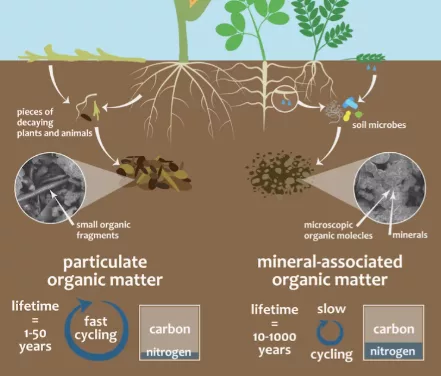
Most of our everyday experience with soil involves the uppermost layers, where decomposing plant material and roots form what scientists call Particulate Organic Matter, or POM. POM’s carbon pool is highly available, fast-cycling, and provides immediate energy for the soil. It is also vulnerable. Changes in tillage, temperature, or moisture can rapidly release this carbon back into the atmosphere. Like a checking account, it is both easy to access and easy to spend.
The “Savings Bond” – Mineral-Associated Organic Matter (MAOM)
Durable soil organic carbon forms wherever roots, fungi, and mineral surfaces interact, often concentrated in subsoil horizons where disturbance is minimal.
There, carbon molecules chemically bond to clay and silt particles, or associate with these minerals, forming Mineral Associated Organic Matter, or MAOM. This layer is the soil’s carbon long term storage vehicle. Once carbon associates with minerals and is stored as MAOM, it is physically protected from microbial decomposition and oxidation. This is the scientific basis for long-term carbon durability. MAOM represents the difference between temporary sequestration and durable, millennia-scale storage.
The Mycorrhizal Broker: Moving Capital into the Vault
Understanding permanence requires understanding the pathway carbon takes from atmospheric CO2 to durable MAOM. Plants photosynthesize, depositing the initial CO2 “cash” into their roots and upper soil layers. But plants alone cannot efficiently move that carbon cash into the deeper soil layers where long-term durability occurs. This is where mycorrhizal inoculants become the essential “broker” in this story.
Mycorrhizal fungi function as biological intermediaries. They take raw photosynthates from the plant and funnel them through an extended mycelial network, transporting carbon deep into the soil matrix.
The fungi extend the root system through microscopic filaments called hyphae, reaching into soil pores that plant roots cannot access. Through specialized proteins that act as biological “glue,” they facilitate the chemical bond between carbon and mineral: the foundation of durable soil carbon.
From a market perspective, this mechanism changes the conversation. The value of mycorrhizal carbon is not just in increasing the amount of soil carbon, but in increasing its quality by moving it from the short-term upper soil checking account to the long-term deep soil vault
Re-defining Durability: The Best of Nature-Based with Hard-Tech Specs
Current carbon market discourse often frames durability as a trade off between engineered and nature-based solutions. Critics contrast the presumed durability of engineered pathways such as DAC or biochar with a caricatured version of nature-based storage.
This is a false dichotomy that flattens the underlying science.
At Groundwork BioAg, we take a systems-based view of carbon dynamics. When growers use our concentrated mycorrhizal inoculants, they are not simply engaged in nature-based sequestration. They are in fact deploying a biological engine that generates Mineral-Associated Organic Carbon with durability specs approaching hard-tech, at the low-CAPEX scalability of agriculture.
Mycorrhizal fungi are nature’s original carbon broker. Carbon is the original currency of life on Earth, and these fungi have been moving it into stable storage for hundreds of millions of years. Our inoculants let growers saturate the MAOM fraction quickly and reliably at commercial scale. While nature-based systems provide the scale and cost effectiveness, mineral chemical bonding provides the stability. Together, they offer a high-integrity solution for durable carbon removal.
Investing in the Future Value of the Acre
The next phase of carbon market development will depend on aligning financial incentives with physical reality.
Our contractual obligations in this field are not limited to paper, but rather are embedded in soil geology, whether we acknowledge it or not. A guarantee in this context is a legal promise that must be paired with the biological and mineral infrastructure that makes durability physically possible.
For the carbon market to mature, we need to move past the permanence debate as a contractual argument and focus on the biological infrastructure that delivers it.
This shift begins with rebuilding soil’s biological infrastructure: the foundation that enables durable carbon storage, resilient agriculture, and long-term climate impact.
If you are underwriting durability risk or building a CDR portfolio and want to see the MAOM data we are generating at commercial scale, reach out to Shawn Gagné at [shawn@groundworkbioag.com].
*Methodology Note:
Groundwork BioAg issues carbon credits under Verra’s VM0042 v2.0, the Methodology for Improved Agricultural Land Management. VM0042 governs the measurement and quantification of soil organic carbon change. Reversal risk is handled at the program level through the VCS AFOLU Non-Permanence Risk Tool and the pooled buffer account.
Let Your Ground Work


